
A pronounceable 5 letter domain commands significantly higher market value than an unpronounceable equivalent because phonetic fluency directly determines brand recall, word-of-mouth velocity, and buyer demand. Domains that pass the “radio test” – meaning a listener can hear the name once, spell it correctly, and recall it later without visual reference – represent the highest tier of short-domain brandability. The consonant-vowel architecture of a five-letter string is the single most reliable predictor of whether it functions as a premium brand asset or a depreciating speculative holding.
Not all five-letter domains are created equal. You may already know that five-letter .com domains are rare, valuable, and increasingly sought-after in the startup naming market. But within that universe, a sharp divide separates the names that sell quickly at premium prices from those that sit unsold for years. That divide has a name: phonetic flow. This article will explain exactly what the pronounceability test is, why it matters more than almost any other valuation metric, and how you can use it to make smarter decisions when selecting or investing in short domain names.
If you’re looking to explore curated, phonetically refined 5 letter domain names for sale built for modern brand builders, Aufic’s marketplace specializes precisely in this category.
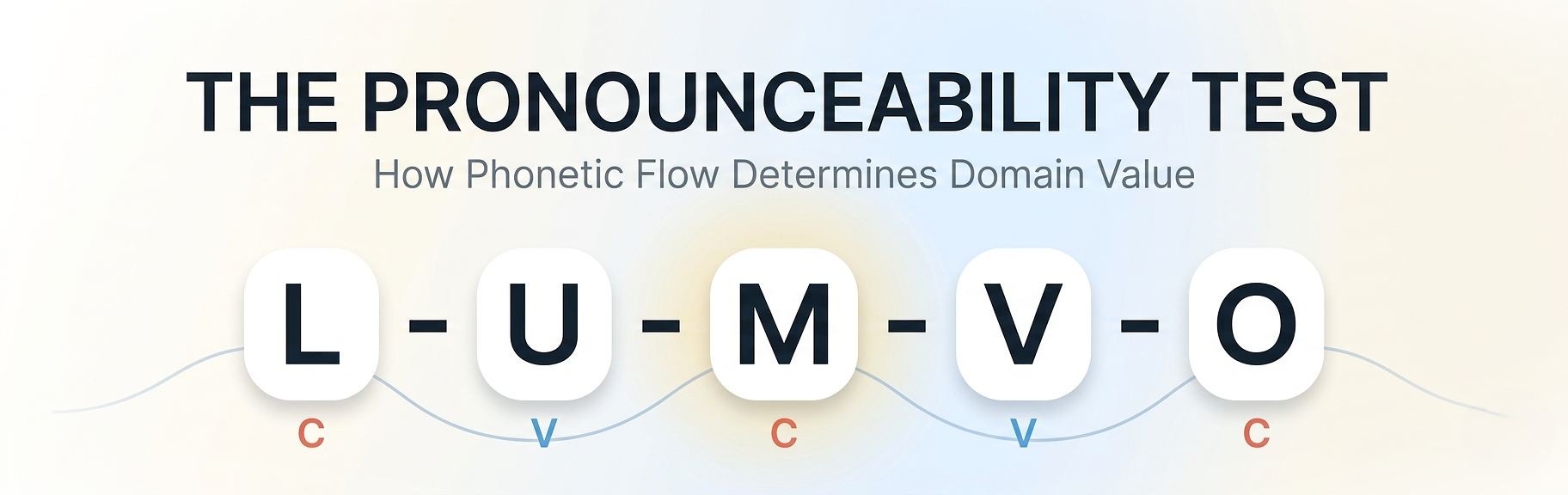
What is Phonetic Flow in a Domain Name?
Phonetic flow refers to how naturally and smoothly a word or name can be spoken aloud. In the context of domain names, it measures whether a five-letter string can be:
- Articulated without hesitation or awkward mouth movements
- Heard once and immediately understood
- Recalled correctly after a short delay
- Spelled without needing clarification
A domain with strong phonetic flow reads as a single, cohesive sound unit. One with poor phonetic flow creates friction: the speaker pauses, the listener mishears, and the brand opportunity dissolves.
According to research discussed across domain investment communities, phonetics matters because brands are social objects. They travel through meetings, podcasts, pitches, and advertisements. Mishearings, corrections, and repeated spellings accumulate into hidden brand costs that erode marketing ROI over time.
Why a Pronounceable 5 Letter Domain Outperforms Its Alternatives
The Scarcity Factor Meets the Sound Factor
Five-letter .com domains sit at a premium intersection: short enough to feel authoritative and modern, yet more accessible than the near-exhausted universe of three- and four-letter combinations. However, scarcity alone does not create value. The real multiplier is pronounceability.
Consider two hypothetical five-letter domains:
- LUMVO.com – consonant-vowel alternation, two natural syllables, smooth delivery
- STRVX.com – dense consonant cluster, no natural syllable break, impossible to say without inventing a pronunciation
Both are five characters. Only one has commercial value.
Brand Recall Is Directly Tied to Pronunciation
Cognitive science research consistently shows that phonetically smooth names are easier to store in working memory. When a name can be “subvocalized” – spoken internally in your head – it benefits from an additional memory pathway that purely visual names cannot access. This is why spoken clarity dramatically increases brand stickiness.
For founders, this translates to:
- Lower customer acquisition cost per brand impression
- Higher word-of-mouth conversion rate
- Faster organic brand recognition
- Reduced need for spelling corrections in advertising copy
The Radio Test: The Gold Standard for Pronounceable Domains
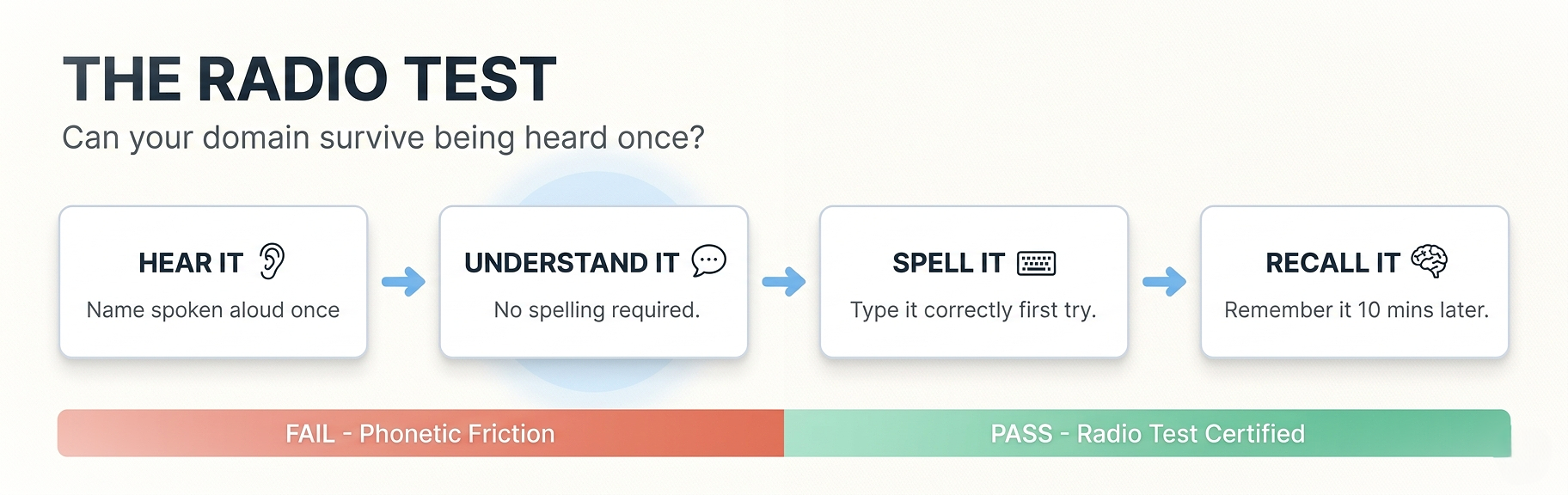
How the Radio Test Works
The radio test is one of the most reliable frameworks in domain valuation. It poses a simple challenge: if your brand name were announced on a radio advertisement – with no visual support, no URL displayed on screen, no social media handle shown – could a listener:
- Hear the name once?
- Understand it immediately?
- Type it correctly without hesitation?
- Remember it 10 minutes later?
If the answer to all four questions is yes, your domain passes the radio test. If any answer is no, phonetic friction is costing your brand money.
According to domain investment specialists, passing the radio test is a core pillar of brandability and distinguishes names that merely look good on a screen from those that perform across all media channels.
Why the Radio Test Matters Even More in 2025 and Beyond
Voice search, AI assistants, podcast advertising, and conversational commerce have fundamentally changed how people encounter brand names. The audio-first internet is no longer a niche consideration; it is mainstream. When Siri, Alexa, or Google Assistant reads out a brand name, phonetic clarity determines whether that exposure converts into a website visit.
A five-letter domain with poor phonetic architecture fails at precisely the moment audio-first media delivers it to a prospect.
The Consonant-Vowel Architecture: Building Blocks of Phonetic Value
Why CVCVC Is the Premier Five-Letter Pattern
The CVCVC pattern – consonant, vowel, consonant, vowel, consonant – represents the most phonetically efficient structure for a five-letter domain. The alternating architecture creates natural syllable breaks that mirror the cadence of most human languages, producing smooth, rhythmic articulation.
Across major world languages, alternating consonants and vowels create the most naturally articulated speech patterns. The mouth opens and closes in a rhythmic sequence, eliminating the articulatory friction caused by consonant clusters.
Examples of strong CVCVC domains:
| DOMAIN PATTERN | EXAMPLE | PHONETIC SCORE | SYLLABLE COUNT |
|---|---|---|---|
| CVCVC | LUMEX | High | 2 |
| CVCVC | NOVAK | High | 2 |
| CVCVC | ZIVOR | High | 2 |
| CVCCV | ZELPA | Medium-High | 2 |
| CCVCC | STRIX | Low | 1 (forced) |
| CCCVC | STRVX | Fails | None natural |
To understand why the CVCVC structure consistently dominates premium domain sales, the detailed analysis in this article on why the CVCVC domain structure is the most sought-after 5-letter pattern provides a comprehensive technical breakdown.
Other Phonetically Strong Patterns
While CVCVC is the gold standard, other patterns also produce strong phonetic flow:
- CVCCV (e.g., ZELPA, TURVA): Two clear syllables, slightly denser but still smooth
- VCVCV (e.g., ARIVO, UNAXI): Vowel-initial, feels modern and open
- CVVCV (e.g., AUREA, NAIRU): Diphthong in center, melodic quality
Patterns to avoid:
- Back-to-back consonant clusters (TRSK-, STRVX-)
- Three or more consecutive consonants
- Ambiguous letter combinations that could produce multiple pronunciations (like “GH” or “PH” in the middle of a constructed name)
The Five-Point Pronounceability Test for Domain Buyers
Before investing in or registering any five-letter domain, apply this structured evaluation framework:
1. The Instant Read Test
Read the domain aloud immediately after seeing it for the first time. Do not analyze it; just say it. If you hesitate or produce an uncertain sound, the domain has failed its first test. Strong pronounceable domains trigger an instant, confident vocalization.
2. The Blind Dictation Test
Say the domain aloud to another person who cannot see it written. Ask them to type exactly what they heard. If they produce the correct spelling on the first attempt, the domain has bidirectional phonetic integrity – meaning its sound maps reliably to its letters and vice versa.
3. The Multi-Accent Test
Consider how the domain sounds when spoken with a British, American, Australian, Indian, or European accent. Global brands need global pronounceability. A name that relies on a specific accent to sound correct will fail in international markets.
4. The Syllable Count Test
Count the natural syllables. For five-letter domains, two syllables is the sweet spot. One syllable feels punchy but may lack warmth. Three syllables for five letters indicates vowel-heavy construction that can feel soft or forgettable. Two syllables balance energy and memorability optimally.
5. The 24-Hour Memory Test
Write the domain down, put it aside, and try to recall it the following day without looking. If it returns to memory easily, it has achieved the kind of phonetic stickiness that drives organic brand growth.
Phonetic Scoring: How Domain Investors Quantify Sound Value
Sophisticated domain investors and marketplace curators do not rely on subjective judgment alone. Phonetic scoring frameworks assign measurable values to specific sound characteristics. Key scoring dimensions include:
Vowel Density Score: The ratio of vowels to consonants. Optimal range for five-letter brandables is typically 2:3 (two vowels, three consonants), matching the CVCVC structure.
Sonority Index: A measure of how “open” and resonant the sounds are. Vowels score highest, followed by liquids (L, R), nasals (M, N), fricatives (S, F, V), and stops (K, T, B).
Cluster Penalty: A deduction applied for each occurrence of two or more adjacent consonants that require special articulation effort.
Rhyme Familiarity Score: Whether the domain rhymes with or phonetically resembles a common English word. Names like “Lumex” or “Novix” carry positive associations because they echo familiar patterns without copying them.
Ambiguity Penalty: Applied when a letter sequence could reasonably be pronounced in multiple ways (e.g., does “CEAU” sound like “SEE-oh” or “SHOH”?).
Common Mistakes Buyers Make When Evaluating Phonetic Domain Value
Mistake 1: Prioritizing Visual Appeal Over Sound
Many buyers select domains based on how they look in a logo or URL. A domain with visually interesting letter combinations may photograph beautifully in mockups but fail completely in audio contexts. Always apply the radio test before any visual evaluation.
Mistake 2: Assuming All Short Domains Are Equally Valuable
Length alone is not a value driver. A pronounceable 5 letter domain with strong phonetic flow may be worth 10 to 100 times more than a five-letter consonant cluster that no one can say aloud consistently. Pronounceability is the multiplier applied to length.
Mistake 3: Ignoring Cross-Cultural Phonetic Compatibility
A name that sounds clean in English may be offensive, humorous, or unpronounceable in a target market’s language. Before finalizing any international brand name, consult native speakers in your primary markets. This is particularly important for tech startups targeting Southeast Asia, Latin America, or Eastern Europe.
Mistake 4: Overvaluing Clever Spellings
Domains with deliberate spelling modifications – substituting “i” for “y,” “k” for “c,” or dropping vowels for stylistic effect – introduce a permanent disconnect between sound and spelling. Every time a prospect hears the brand name, they must consciously recall the unconventional spelling. This friction compounds over time and erodes brand equity.
Mistake 5: Neglecting the Ending Consonant Quality
The final letter of a five-letter domain heavily influences its memorability and perceived energy. Hard stops (K, T, X) create assertive, modern-feeling names. Soft endings (L, R, M, N) produce warmer, more approachable brand personalities. Neither is inherently superior; the choice should align with brand positioning strategy.
Phonetic Value by Industry: What Sounds Right for Your Sector
Different industries gravitate toward different phonetic profiles. Understanding these conventions helps you select a pronounceable 5 letter domain that resonates with your target audience immediately.
Comparison Table: Phonetic Preferences by Industry
| INDUSTRY | PREFERRED SOUNDS | EXAMPLES | AVOIDED PATTERNS |
|---|---|---|---|
| Tech / SaaS | Crisp stops, X endings | PIXAR, ZEMOX | Heavy vowel clusters |
| Healthcare | Soft consonants, open vowels | LUMEA, ZOVIR | Harsh stops, clusters |
| Finance | Short, authoritative | NEXAR, VOLVX | Playful sounds |
| E-commerce / Retail | Friendly, two-syllable | LUMIO, TRIVA | Hard clusters |
| Creative / Agency | Melodic, flowing | AUREX, NOVAL | Monotone patterns |
| Gaming / Entertainment | Energetic, sharp | ZIVAX, KROMO | Soft, weak endings |
Expert Tips for Selecting a High-Value Pronounceable Domain
Tip 1: Start with the sound, not the spelling. Before you type anything into a domain search tool, say the name you want aloud first. Then work backward to its most natural spelling.
Tip 2: Use the CVCVC checklist. Run every candidate through the CVCVC pattern test. If it qualifies, score it higher automatically. If it deviates, assess whether the deviation adds phonetic complexity or merely reduces clarity.
Tip 3: Test with non-native English speakers. The most globally valuable pronounceable 5 letter domains are those that can be said naturally by speakers of multiple language families. If only native English speakers can pronounce it cleanly, your addressable market is limited.
Tip 4: Check for audio proximity to existing brands. A domain that sounds too similar to an existing brand creates legal risk and audience confusion. Tools for phonetic similarity analysis can identify problematic overlaps before you invest.
Tip 5: Evaluate the full brand system. Consider how the domain sounds as an email address, as a spoken URL in a podcast ad, and as a spoken hashtag in a social media video. The name needs to work in all these contexts simultaneously.
Tip 6: Prioritize curated marketplaces over bulk registrars. Hand-registered domains from bulk tools often prioritize letter combinations that look available rather than sound exceptional. Curated marketplaces pre-screen for phonetic quality, saving you time and reducing risk.
How Phonetic Quality Affects Domain Resale Value
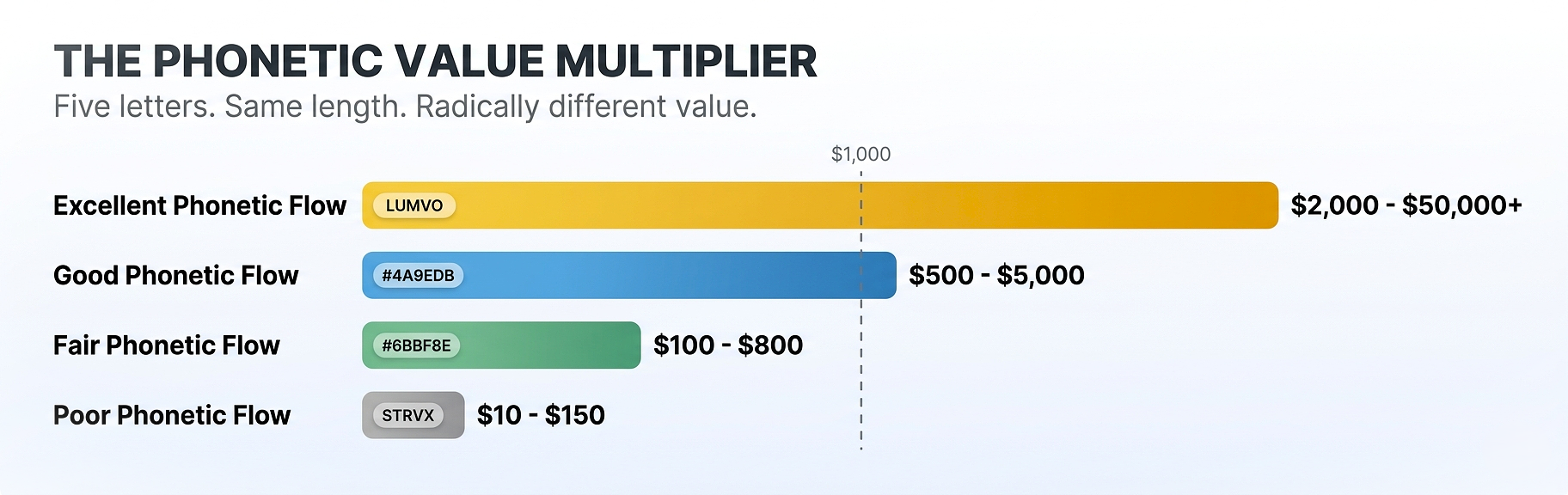
The financial case for phonetic quality is well documented in domain investment data. Here is a breakdown of how pronounceability tier affects typical resale value for five-letter .com domains:
| PRONOUNCEABILITY TIER | CHARACTERISTICS | TYPICAL RESALE RANGE |
|---|---|---|
| Tier 1 – Excellent | CVCVC, two syllables, passes radio test, no ambiguity | $2,000 – $50,000+ |
| Tier 2 – Good | Near-CVCVC, minor cluster, mostly unambiguous | $500 – $5,000 |
| Tier 3 – Fair | Mixed pattern, some phonetic friction, limited ambiguity | $100 – $800 |
| Tier 4 – Poor | Consonant clusters, ambiguous pronunciation, fails radio test | $10 – $150 |
The jump from Tier 3 to Tier 1 represents a potential 100x or greater increase in value – driven almost entirely by phonetic quality rather than letter count.
Data from domain investment research indicates that five-letter pronounceable combinations in the mid-range command $250 to $5,000 based on phonetic appeal, partial English roots, and visual flow. Premium tier combinations with optimal phonetic scoring regularly exceed this range when acquired through curated sources.
Phonetic Flow and SEO: The Indirect but Real Connection
You might wonder whether phonetic quality has any bearing on SEO performance. The connection is indirect but genuine, and it operates through several mechanisms:
Branded search volume: A name that users can easily remember and spell generates more direct branded searches. Google treats rising branded search volume as a trust signal that contributes positively to overall domain authority.
Backlink anchor text accuracy: When bloggers, journalists, and partners link to your site, they type your brand name as they remember it. If phonetic ambiguity causes misspelling, those backlinks may point to incorrect URLs or competitor domains.
Voice search optimization: As voice search continues to grow as a share of total search queries, phonetically clear brand names gain a structural advantage. Voice assistants match spoken queries to brand names more reliably when the phonetic signature is unambiguous.
Click-through rate in SERPs: Users scanning search results are more likely to click on a brand name they have heard before, can subvocalize naturally, and recognize as trustworthy. Phonetic memorability contributes to brand recognition, which influences CTR.
Step-by-Step Guide: Applying the Pronounceability Test Before You Buy
Follow this sequence whenever you are evaluating a five-letter domain for purchase:
- Write down the domain exactly as it appears, without any preconceptions.
- Read it aloud immediately, once, without overthinking. Note whether you produced a confident sound or hesitated.
- Identify the vowel-consonant pattern (write out C and V for each letter). Note whether the pattern follows CVCVC or deviates significantly.
- Count the natural syllables. Two syllables is ideal. One or three is acceptable. Anything else warrants caution.
- Perform the blind dictation test. Say it to someone nearby and ask for an immediate spelling.
- Check for phonetic similarity to existing brands in your industry using a quick search.
- Apply the multi-accent consideration. Think through how it sounds in British, American, Spanish, and Indian English.
- Evaluate the final consonant. Does it end with appropriate energy for your brand positioning?
- Score it on a 1-10 scale across: instant readability, blind dictation accuracy, syllable balance, and cross-cultural ease.
- Make the purchase decision based on phonetic score combined with availability, price, and brand fit.
Frequently Asked Questions
What makes a 5 letter domain pronounceable?
A pronounceable 5 letter domain typically features a clear consonant-vowel alternation (such as the CVCVC pattern), two natural syllables, and no ambiguous letter combinations. The name should be speakable in a single confident attempt without rehearsal, and the listener should be able to spell it correctly after hearing it once.
How much more valuable is a pronounceable 5 letter domain compared to an unpronounceable one?
The value difference can be significant. Unpronounceable five-letter strings composed mainly of consonants often sell for $10 to $150, while phonetically clean, CVCVC-patterned domains regularly command $2,000 to $50,000 or more depending on brand strength and market demand. Pronounceability is one of the highest-leverage value multipliers in short domain investing.
What is the radio test for domain names?
The radio test evaluates whether a domain name can be heard once – as if announced in a radio advertisement – and then immediately understood, spelled correctly, and remembered by the listener. A domain that passes the radio test is considered phonetically sound, which directly supports brand recall and word-of-mouth marketing.
Does a pronounceable 5 letter domain help with SEO?
Yes, indirectly. A phonetically memorable domain generates higher branded search volume, more accurate backlink anchor text, better performance in voice search queries, and improved click-through rates in search results. These factors collectively contribute to stronger domain authority and organic search performance over time.
What phonetic patterns should I avoid in a 5 letter domain?
Avoid consecutive consonant clusters (two or more consonants in a row), letter combinations that produce ambiguous pronunciations, and endings that require unusual mouth movements. Strings like STRVX or CLNSK fail multiple phonetic tests simultaneously and are unlikely to hold brand value regardless of market conditions.
Are CVCVC domains still available to register or buy?
Pure CVCVC .com domains are largely registered, making the secondary market the primary acquisition channel. Specialized marketplaces that curate phonetically optimized short domains offer the most reliable source for available five-letter brandables that have been pre-screened for phonetic quality.
How do I test if my preferred domain passes the pronounceability test?
Apply the five-point framework: the instant read test, the blind dictation test, the multi-accent test, the syllable count test, and the 24-hour memory test. A domain that passes all five consistently qualifies as a high-value pronounceable brandable worth pursuing at a premium price.
Conclusion: Phonetic Flow is the True Measure of Domain Value
When investors, founders, and brand strategists argue over which five-letter domain is “worth more,” they are ultimately arguing about phonetics. The answer, once you understand the mechanics, is consistent: the domain that anyone can say, hear, remember, and spell – the one that passes the radio test in every accent and context – is always worth more.
A well-chosen pronounceable 5 letter domain is not just a web address. It is a brand asset that compounds in value with every podcast mention, every word-of-mouth referral, and every voice search query. Its phonetic fluency does the marketing work that you would otherwise have to pay for through repeated advertising spend and brand correction campaigns.
The pronounceability test is therefore not an aesthetic preference. It is a financial discipline, a brand strategy tool, and a competitive advantage – all compressed into the question: “Can someone say it, hear it, and spell it correctly the first time?”
If the answer is yes, you have found a domain worth owning.
Ready to acquire a premium phonetically optimized short domain for your brand? Browse curated 5 letter domain names for sale at Aufic and find a name that works as hard as your business does.
Pingback: Domain Trademark Conflict: How to Check Before You Buy