
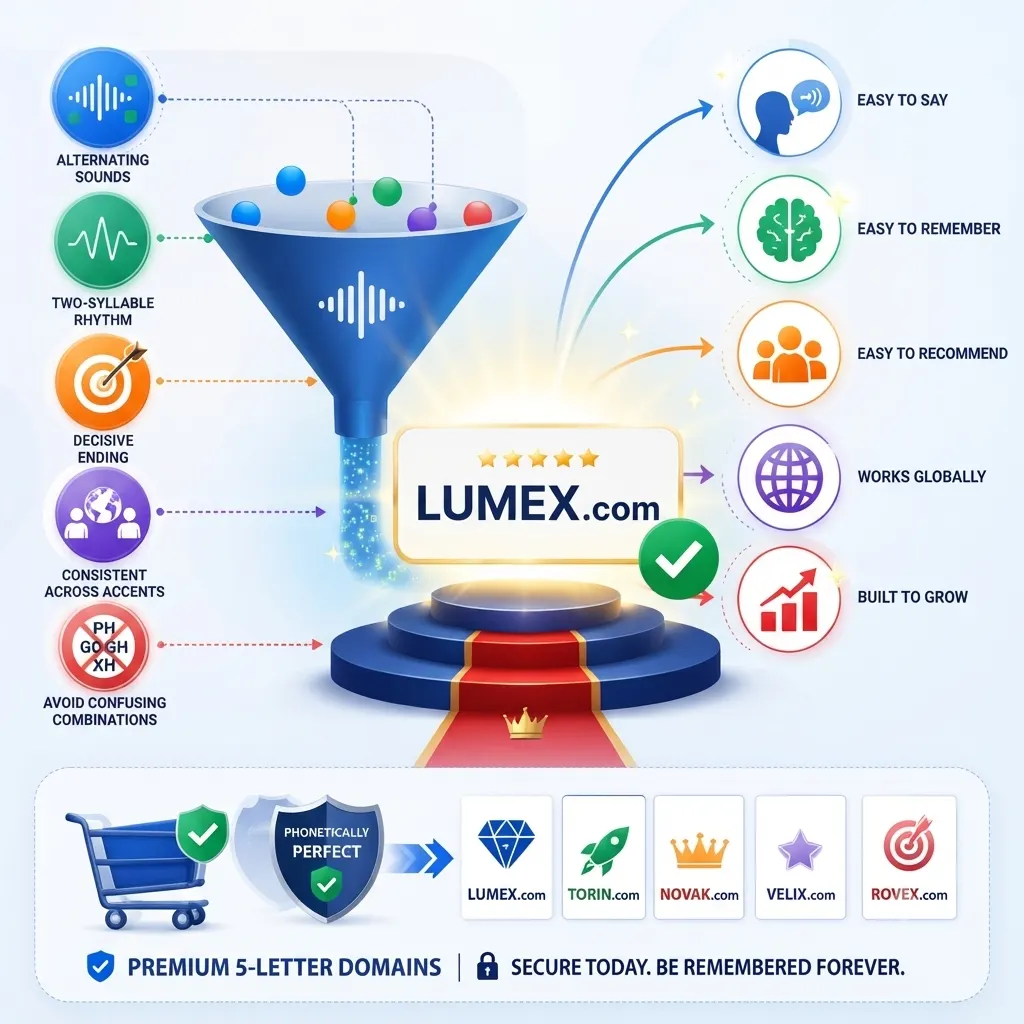
Phonetic brand name rules govern how a five-letter domain sounds when spoken aloud, and that sound, not the spelling, is what determines whether a name is remembered, repeated, and typed correctly. A domain that alternates consonants and vowels, settles into two natural syllables, and ends on a clear consonant sound will outperform a visually clever but phonetically clumsy alternative in almost every real-world context. These rules are not a stylistic preference; they are the measurable difference between a name that spreads by word of mouth and one that gets misheard, misspelled, and forgotten.
Most founders choose a domain by staring at a screen. They test how it looks in a logo mockup, whether it fits a favorite font, and whether the .com is available. Almost nobody says the name out loud before buying it, which is precisely why so many otherwise promising five-letter domains never build the brand recognition their owners expected. If you are browsing Aufic’s curated 5 letter domain names for sale, understanding phonetic brand name rules before you shortlist anything will save you from the single most common (and most expensive) naming mistake.
What Are Phonetic Brand Name Rules?
Phonetic brand name rules are a set of sound-based guidelines that predict how easily a name travels through speech. They cover four things: how the consonants and vowels alternate, how many syllables the name naturally forms, how the name ends, and whether its pronunciation stays consistent across accents. A name that satisfies all four is, functionally, easier to remember than one that doesn’t.
Unlike trademark checks or availability searches, phonetic evaluation happens entirely in the ear. That’s exactly why it gets skipped. It requires actually speaking the candidate name aloud, rather than scanning it visually, and most naming shortlists never make it past the screen.
5 PHONETIC BRAND NAME RULES
Sound-Based Guidelines For Memorable Brands
Creates natural rhythm for easy pronunciation.
The sweet spot for memory and recall.
Use K, X, T, V, P for impact.
Prevent mishearing with clear spellings.
Consistent sound globally.
Why the Human Brain Prefers Certain Sounds
Not all sounds are processed equally by the brain. Research in cognitive linguistics suggests that names with predictable sound patterns require less mental effort to decode and therefore remain in memory longer.
For example:
- Mivox is processed quickly because the pronunciation is obvious.
- Xqryn requires mental effort to decode and is less likely to be remembered.
This phenomenon is sometimes referred to as processing fluency—the easier something is to process, the more positively people tend to perceive it.
Sound Creates Brand Personality
Even before a customer knows what your company does, the sound of your name creates expectations.
Examples:
| Sound Type | Emotional Impression |
|---|---|
| Hard consonants (K, T, X) | Strength, technology, precision |
| Soft consonants (M, L, N) | Friendliness, warmth |
| Long vowels | Premium, elegance |
| Short vowels | Energy, speed |
The sound of a domain can therefore influence first impressions before any marketing begins.
Rule 1: Alternate Consonants and Vowels for Natural Rhythm
The single highest-leverage rule in phonetic branding is alternation. Every language on earth favors a rhythm where consonants and vowels take turns; consequently, names that follow this pattern feel instantly familiar, even when the word itself is invented.
For a five-letter domain, the strongest expression of this rule is the CVCVC pattern (consonant, vowel, consonant, vowel, consonant), which our dedicated breakdown of why the CVCVC structure dominates the five-letter market covers in far more technical depth. In short, alternation removes the consonant clusters that force a speaker to pause, stumble, or invent a pronunciation on the spot.
- Strong alternation: LUMEX, NOVAK, TORIN
- Weak alternation: STRVX, GLYNK, XHRTA
Why CVCVC Patterns Feel Familiar
Most languages naturally develop around alternating consonant and vowel sounds because they require less effort to pronounce.
Examples:
- Robot
- Lemon
- Music
- Basic
This pattern allows the mouth to transition smoothly between sounds without awkward pauses.
Better Word-of-Mouth Sharing
Alternating sounds are particularly valuable for:
- Podcast advertisements
- Verbal referrals
- Sales presentations
- Radio mentions
- Networking events
A name that can be repeated easily has a higher chance of spreading organically.
Pronunciation Speed Matters
Names with alternating patterns are usually spoken faster and more confidently, reducing the hesitation that often accompanies complex names.
Rule 2: Keep the Syllable Count at Two
Two syllables is the sweet spot for a five-letter name. One syllable can feel abrupt and hard to expand into a full brand voice, while three syllables packed into five letters usually means the name is vowel-heavy to the point of sounding soft or forgettable.
A quick way to check syllable count is to say the name slowly and count where your mouth naturally pauses. “Ro-vex” pauses once, cleanly, and lands as two syllables. “Ae-ui-on” pauses twice and starts to blur. This lines up with broader usability findings from the Nielsen Norman Group’s research on working memory limits, which shows that shorter, cleanly segmented chunks of information are retained far more reliably than longer or irregular ones.
Why Two Syllables Dominate Branding
Many of the world’s largest brands use two-syllable names because they strike an ideal balance between brevity and personality.
Examples:
- Apple
- Amazon
- Tesla
- Canva
Two syllables provide enough room for character while remaining easy to remember.
Easier Integration Into Marketing
Two-syllable names often work better in:
- Slogans
- Jingles
- Podcast ads
- Voice assistants
- Video introductions
This flexibility can have long-term branding advantages.
Better Email and Verbal Communication
Short names with two syllables are generally easier to:
- Say over the phone
- Introduce in meetings
- Include in presentations
- Use in customer support interactions
Rule 3: End on a Decisive Consonant Sound
The final letter of a five-letter domain carries more weight than most founders expect. Names that end on a hard consonant, such as K, X, T, or V, land with confidence and authority. Names that trail off on an open vowel sound softer and, in some cases, less memorable in fast-paced spoken contexts like podcast ads or sales calls.
Neither ending is objectively better for every brand. A wellness product might benefit from a softer, vowel-led close, while a fintech or SaaS brand often leans on the sharper, consonant-terminated sound. What matters is that the choice is deliberate rather than accidental.
Terminal Sounds Affect Perceived Authority
Hard endings can create a sense of confidence and finality.
Examples:
| Ending | Impression |
|---|---|
| K | Strong |
| X | Innovative |
| T | Precise |
| P | Energetic |
| V | Modern |
This is one reason many technology companies favor consonant endings.
Softer Endings Can Be Strategic Too
Brands in industries such as:
- Wellness
- Beauty
- Lifestyle
- Hospitality
may intentionally choose softer endings because they sound more approachable and calming.
Endings Influence Logo Design
Certain final letters naturally produce stronger visual balance in logos and typography, particularly letters with:
- Straight lines
- Sharp edges
- Symmetrical forms
Rule 4: Avoid Ambiguous Letter Clusters
Some letter combinations simply do not resolve to one clear sound. “PH,” “GH,” and double-consonant blends in the middle of a constructed name force the listener to guess, and a guess is a mishearing waiting to happen. If two people can reasonably pronounce your domain two different ways, the ambiguity penalty is already eating into your brand recall before you have spent a single rupee on marketing.
This is one of the reasons pronounceability carries such a heavy weight in resale value; our detailed look at how phonetic flow determines a domain’s real market value walks through exactly how ambiguity shows up in pricing data.
Ambiguity Increases Customer Friction
Every additional pronunciation possibility creates friction.
Questions customers may ask:
- Is the “ph” pronounced like “f”?
- Is the “gh” silent?
- Does the “x” sound like “ks” or “z”?
Every moment of uncertainty reduces recall.
Ambiguous Names Increase Marketing Costs
Brands with difficult pronunciations often need:
- Additional advertising
- Repeated pronunciation guidance
- More customer education
A clearer name can reduce these costs.
Search and Voice Recognition Issues
Voice assistants may struggle with:
- Unusual consonant combinations
- Missing vowels
- Stylized spellings
This can affect discoverability in voice search environments.
Rule 5: Test Cross-Accent Clarity
A name that works perfectly in a General American accent can fall apart in British, Indian, or Australian English, and global brands cannot afford that inconsistency. Before finalizing a shortlist, read each candidate aloud in as many accents as you can access, or ask colleagues from different regions to pronounce it cold. This matters more each year as voice interfaces grow; Edison Research’s ongoing smart audio reporting tracks how much everyday commerce now starts as a spoken query rather than a typed one, which makes accent-proof pronunciation a genuine business consideration, not just a branding nicety.
According to the American Speech-Language-Hearing Association’s overview of speech sound acquisition, consonant-vowel alternation is among the first and most universally acquired speech patterns across languages, which is exactly why it travels so well across accents and doesn’t require region-specific training to land correctly.
Global Businesses Need Pronunciation Consistency
A domain may perform well locally but become problematic internationally.
Consider testing:
- North American English
- British English
- Indian English
- Australian English
International clarity becomes increasingly important as businesses expand globally.
Consider Multilingual Customers
Even if your company operates in English, many customers may speak English as a second language.
Simple phonetic structures generally:
- Improve recall
- Reduce spelling errors
- Increase confidence in referrals
Customer Support Benefits
Easy pronunciation reduces friction during:
- Phone support
- Sales calls
- Video meetings
- Conference introductions
Additional Content for: Quick-Reference Table
Create a Weighted Scoring System
Instead of simply passing or failing each rule, score every candidate.
| Rule | Score (1-10) |
|---|---|
| Alternation | |
| Syllables | |
| Ending | |
| Clarity | |
| Accent Stability |
This creates a more objective naming process.
Quick-Reference Table: The Five Phonetic Brand Name Rules
| Rule | What to Check | Pass Example | Fail Example |
|---|---|---|---|
| 1. Alternation | Consonants and vowels take turns | LUMEX | STRVX |
| 2. Syllable Count | Settles into two syllables | NOVAK | AEUIO |
| 3. Terminal Sound | Ends on a clear, intentional sound | TORIK | ZOEIA |
| 4. No Ambiguity | Only one reasonable pronunciation | RAVEN | PHYNX |
| 5. Accent Stability | Sounds consistent across regions | MELON | QUIRV |
Comparison Table: Phonetic Pattern vs Memorability Score
Memorability Isn’t Binary
A name doesn’t need to be perfect to succeed.
Different patterns may work depending on:
- Industry
- Audience
- Brand personality
- Marketing budget
However, easier patterns generally reduce the amount of branding effort required.
Phonetics and Trust
Studies in naming psychology suggest that names that are easier to pronounce are often perceived as:
- More trustworthy
- More familiar
- More credible
This effect can influence first impressions significantly.
| Pattern | Example | Syllables | Relative Memorability |
|---|---|---|---|
| CVCVC | Rafik | 2 | Highest |
| CVCCV | Zelpa | 2 | High |
| VCVCV | Arivo | 3 | Moderate |
| CCVCC | Strix | 1 (forced) | Low |
| CCCVC | Strvx | None natural | Fails |
Common Mistakes When Applying Phonetic Brand Name Rules
Mistake 1: Judging the Name by Its Logo Mockup First
A name that looks striking in a logo file can still fail the spoken test. Always say a candidate aloud before you fall in love with how it renders visually.
Mistake 2: Assuming Any Short Name Is an Easy Name
Five letters does not automatically mean five easy sounds. A short, consonant-dense string can be harder to say than a longer, well-structured word.
Mistake 3: Skipping the Non-Native Speaker Test
A name that sounds obvious to a native English speaker may not translate cleanly to global audiences, which matters enormously for any startup planning international growth.
Mistake 4: Choosing Stylized Spelling Over Sound
Swapping “c” for “k,” dropping vowels, or adding a silent letter for style permanently disconnects sound from spelling, and every listener has to relearn that gap every time they hear the name.
Mistake 5: Ignoring Domain Extensions During Testing
A name may sound excellent on its own but awkward when spoken with its extension.
Say the full domain aloud:
- Torik dot com
- Lumex dot io
- Novik dot co
The complete spoken experience matters.
Mistake 6: Relying Entirely on AI Name Generators
AI tools can produce creative names, but they often prioritize availability over pronunciation quality.
Always conduct manual phonetic testing.
Mistake 7: Testing Names Alone
People naturally become biased toward names they created themselves.
Ask others:
- How would you pronounce it?
- How would you spell it?
- What industry does it sound like?
Fresh perspectives reveal weaknesses quickly.
Expert Tips for Naming a Phonetically Strong 5-Letter Domain
- Say it before you spell it. Speak candidate names out loud first, then work backward to the written form.
- Score against the CVCVC checklist. Names that fit the pattern automatically clear the alternation and syllable-count rules together.
- Read it in a noisy room. If it survives a busy café or a patchy phone line, it will survive a pitch deck.
- Check it against your email format. Say “hello at [name] dot com” aloud; if that phrase is clean and confident, the domain has passed a real-world test.
- Shortlist from curated inventory rather than random generators. Names that reach a curated domain naming resource library have usually already cleared a basic phonetic screen, which narrows your review time considerably.
Test Recall After Delay
Tell someone the name once.
Then ask them:
- Ten minutes later
- One hour later
- The next day
Can they still remember it?
Delayed recall is one of the best indicators of long-term memorability.
Check Voice Assistant Recognition
Ask:
- Siri
- Google Assistant
- Alexa
to recognize and repeat the name.
This is an increasingly useful test in a voice-first digital environment.
Use the “Phone Call Test”
Imagine introducing your company over a noisy phone line.
If you immediately need to spell the name, it may not be as strong as it initially appeared.
Step-by-Step: Applying Phonetic Brand Name Rules to Your Shortlist
- Write down every candidate exactly as it appears, without editing.
- Mark each letter as a consonant (C) or vowel (V) to reveal the pattern.
- Read each name aloud once, without rehearsing, and note any hesitation.
- Ask someone who has not seen the name to spell it back after hearing it.
- Cross-check pronunciation across at least two accents.
- Rank the survivors and compare pricing against typical resale data, which our verified 5-letter domain cost breakdown covers in detail.
- Confirm availability and lock in your final choice.
Add an Emotional Scoring Stage
After phonetic testing, ask:
- Does the name sound premium?
- Does it sound trustworthy?
- Does it sound innovative?
- Does it fit the industry?
Sound and emotional fit should work together.
Compare With Competitors
Write your candidate names next to competitors.
Questions:
- Does your name stand out?
- Is it easier to pronounce?
- Is it more memorable?
Competitive comparison often changes final decisions.
Frequently Asked Questions
What are phonetic brand name rules?
Phonetic brand name rules are the sound-based guidelines that determine whether a name is easy to say, hear, and remember. For 5-letter domains, this means alternating consonants and vowels, keeping the syllable count near two, and closing on a clear, unambiguous consonant sound.
Why does phonetic structure matter more than spelling for a domain name?
People hear a brand name in conversation, on a podcast, or in a voice assistant response far more often than they read it letter by letter. If the spoken form is unclear, the written form rarely gets typed correctly, which is why phonetic structure drives recall before spelling ever comes into play.
What is the easiest phonetic rule to apply when naming a domain?
Alternating consonants and vowels is the simplest and most reliable rule. A pattern such as CVCVC creates a natural two-syllable rhythm that almost any speaker can pronounce correctly on the first try.
Can a 5-letter domain break phonetic brand name rules and still succeed?
Occasionally, though it’s the exception rather than the strategy. Brands that break these rules usually spend years and heavy advertising budgets training audiences on pronunciation, a cost that phonetically sound names avoid from day one.
How do I test whether my domain name follows solid phonetic brand name rules?
Say the name aloud to someone who has never seen it written and ask them to spell it back to you. If they get it right on the first attempt, in more than one accent, the name is phonetically sound.
Why do so many startup names end with “x”?
The letter “x” often conveys innovation, technology, and modernity while providing a strong, decisive ending.
Should a domain sound like a real word?
Not necessarily. Invented words can be highly memorable if they follow strong phonetic principles and are easy to pronounce.
Are vowel-heavy names bad?
No. They simply create a different emotional tone, often sounding softer and more approachable.
Can pronunciation affect conversion rates?
Indirectly, yes. Easier names are:
- Shared more often
- Remembered more easily
- Searched more accurately
- Trusted more quickly
All of these factors can contribute to better marketing performance.
Let Sound, Not Just Spelling, Guide Your Domain Choice
Phonetic brand name rules aren’t an academic exercise reserved for linguists; they are a practical filter that every founder shortlisting a five-letter domain should run before committing to a name. Alternating sounds, a clean two-syllable rhythm, a decisive ending, and consistency across accents together determine whether a name gets remembered or gets misheard into oblivion. Applying these rules early costs nothing and saves years of correcting mispronunciations in sales calls, podcast mentions, and word-of-mouth referrals.
Sound is a Long-Term Branding Asset
Every advertisement, podcast mention, customer referral, and sales presentation depends on people saying your brand name correctly.
A phonetically strong domain reduces:
- Repetition costs
- Customer confusion
- Spelling errors
- Lost referrals
Over time, the cumulative advantage of a memorable sound can become one of the most valuable characteristics of a premium five-letter domain.
Browse Our Unique Collection of Premium 5-Letter Domain Names →