
An AI brand naming domain tool generates pronounceable, brandable word combinations by scanning linguistic patterns, checking live registry availability, and scoring phonetic memorability in seconds. This has compressed a process that once took founders weeks into a workflow that takes hours. The result is a faster-moving, more competitive 5-letter domain market where speed of discovery now matters almost as much as the name itself.


The shift did not happen overnight. For most of the last two decades, naming a brand meant a founder, a notepad, and a domain availability checker refreshed a hundred times over a weekend. Today, that process runs through large language models trained on phonetics, trademark databases, and linguistic root libraries. If you are evaluating a premium 5-letter domain name for your next brand, understanding how AI-assisted naming actually works, and where it still needs a human editor, is the difference between buying a domain that compounds in value and one that gets abandoned in a shopping cart.
This guide breaks down what AI brand naming domain tools are, how they are reshaping demand in the 5-letter space, where they fall short, and how to combine automated discovery with the judgment that only comes from understanding brand strategy.
What Is an AI Brand Naming Domain Tool?
An AI brand naming domain tool is software that uses machine learning, most often a large language model layered with domain-registry APIs, to generate, filter, and rank potential business names against live availability data. Instead of manually brainstorming syllables, founders type a niche, a tone, and a target length, and the tool returns dozens of options within seconds.

At a baseline level, these tools perform three jobs at once:
- Generation – producing combinations of phonemes, prefixes, and word blends that fit a requested length or pattern.
- Filtering – cross-checking each candidate against domain registries, trademark databases, and social handle availability.
- Scoring – ranking outputs by pronounceability, memorability, and sometimes even search-volume potential.
For the 5-letter domain market specifically, this generation-filtering-scoring loop is uniquely powerful. Five-letter combinations sit in a linguistic sweet spot: short enough to feel premium, long enough to be pronounceable, and numerous enough that AI tools can still find genuinely available options where four-letter and three-letter inventory has largely dried up.
Why 5-Letter Domains Became the AI Naming Testing Ground
Every new naming technology eventually gets stress-tested against the hardest inventory problem in the domain world, and right now that problem is five letters.
Scarcity Changed the Math
Three- and four-letter dot-com domains were exhausted by institutional buyers and early registrants years ago. Five-letter dot-coms are the last tier where organic, brandable, pronounceable combinations still exist in meaningful volume, which is exactly why AI tools gravitated here first. A generation engine that can comb through tens of thousands of five-character permutations in minutes has an obvious advantage over a human working through a rhyming dictionary.
The CVCVC Pattern Became a Default Output
Ask most AI naming tools for a short, brandable name and a disproportionate share of the results will follow a consonant-vowel-consonant-vowel-consonant, or CVCVC, structure, such as Rovix or Tamlo. This is not a coincidence. As explored in our breakdown of why the CVCVC structure is the most sought-after five-letter pattern, CVCVC names are statistically the easiest for the human brain to parse and recall, which means AI models trained partly on branding literature converge on the same pattern human namers have favored for decades.
Founders Want Speed Without Sacrificing Length Discipline
Modern startup naming briefs increasingly specify length as a hard constraint before anything else. Our piece on why domain length can decide brand survival covers this in depth, but the short version is that shorter names load faster in memory, fit better on mobile screens, and travel more easily across markets. AI tools that can filter for length first and creativity second fit this brief perfectly.

How AI Brand Naming Tools Actually Work
Understanding the mechanics matters because it explains both the strengths and the blind spots of this technology.
Linguistic Pattern Generation
Most tools start with a corpus of phonemes and morphemes drawn from multiple languages, then recombine them using probability models trained to favor combinations that sound natural to an English-speaking ear. This is why AI-generated names often sound vaguely Latin, Scandinavian, or invented-tech-brand in tone; the training data skews toward what has historically sold in Silicon Valley naming culture.
Real-Time Registry and Trademark Screening
A generated name is worthless if it is already registered or legally encumbered. Better AI naming platforms connect directly to registrar APIs to confirm live availability, and increasingly they run a shallow trademark conflict scan as well. That said, this automated screening is not a substitute for a real search; our guide on how to check for a domain trademark conflict before you buy walks through why a human legal review still matters even after an AI tool gives a name the green light.
Phonetic and Pronounceability Scoring
The most advanced tools assign each candidate a phonetic score based on syllable stress, consonant clustering, and cross-language pronounceability. This scoring logic borrows heavily from academic work on word memorability. Our article on phonetic brand name rules for memorable five-letter domains explains the underlying rules these algorithms are approximating, including why hard consonant openings and vowel-heavy endings tend to score higher.
Extension and Market-Fit Filtering
Once a name clears the generation and screening stage, many tools now layer in extension recommendations, flagging whether a name is better suited to .com, .io, or another TLD based on industry norms. This connects directly to decisions covered in dot-com versus dot-io for five-letter domains, where extension choice can shift both perceived credibility and resale value.

The Market Shift: Manual Brainstorming vs AI-Assisted Discovery
The clearest way to see the impact of AI brand naming domain tools is to compare the old workflow against the new one.
| Naming Task | Manual Process (Pre-AI) | AI-Assisted Process (Current) |
|---|---|---|
| Idea generation | Hours of brainstorming, thesaurus and rhyme lookups | Hundreds of candidates in under a minute |
| Availability checking | One-by-one manual lookups on registrar sites | Bulk real-time API checks across registries |
| Trademark screening | Separate manual search, often skipped by early-stage founders | Automated shallow scan, still needs manual legal follow-up |
| Phonetic evaluation | Subjective, based on founder or agency taste | Scored against pronounceability and syllable-stress models |
| Time to shortlist | Days to weeks | Hours |
| Risk of missing available inventory | High, especially in the crowded 5-letter tier | Lower, since AI can surface long-tail combinations a human would not think to try |
This compression in timeline is the single biggest driver of demand pressure in the 5-letter domain market. When discovery takes hours instead of weeks, more buyers compete for the same freshly surfaced inventory, which pushes desirable names into acquisition or resale channels faster than in previous years.
Where AI Naming Tools Still Fall Short
Speed is not the same as judgment, and this is where AI brand naming domain tools consistently underperform against experienced human curation.
| Limitation | What Happens | Why It Matters |
|---|---|---|
| Cultural and market nuance | Names can sound fine in English but carry unintended meaning in another language or market | Global brands risk costly rebrands post-launch |
| Trademark depth | Automated scans check obvious registered marks, not common-law or pending applications | Legal exposure can surface months after a name is already in market |
| Brand story and positioning | AI optimizes for pronounceability, not narrative fit with a company’s mission | A phonetically strong name can still feel generic or off-brand |
| Emotional resonance | Algorithms cannot judge how a name feels to a target customer | Human testing and focus groups remain necessary |
| Aftermarket value judgment | Tools rarely factor in resale liquidity, historical sales comps, or brand-tier positioning | Buyers can overpay for a name with weak resale fundamentals |
This is precisely the gap that curated premium marketplaces exist to fill. A generation algorithm can hand you a thousand available five-letter strings; it cannot tell you which ten are actually investment-grade.
5-Letter Domain Market Trends Being Driven by AI

Several measurable shifts in the market trace directly back to AI-assisted naming adoption.
Fintech is moving faster than any other vertical. Financial technology brands need names that feel trustworthy, short, and globally pronounceable all at once, and AI tools are particularly good at hitting that narrow brief. Our analysis of why fintech startups are choosing 5-letter dot-com domains shows this pattern accelerating as more fintech founders run AI-generated shortlists before ever contacting a broker.
Buyers are entering the market with pre-vetted shortlists instead of open questions. Rather than asking a marketplace “what’s available,” AI-savvy buyers now arrive with five or six AI-generated names and ask specifically whether those are for sale or comparable to listed inventory. This changes how marketplaces need to structure search and discovery.
Extension expectations have tightened. Because AI tools frequently suggest a preferred extension alongside a name, buyer expectations around .com versus alternative extensions have become more rigid, with less willingness to compromise than in prior buying cycles.
Resale timelines are compressing. Names algorithmically flagged as high-scoring on pronounceability metrics tend to attract faster secondary-market interest once listed, since buyers increasingly trust automated scoring as a first filter.
Common Mistakes Businesses Make When Using AI Naming Tools

Even sophisticated founders run into predictable pitfalls when they lean on AI-generated shortlists without additional diligence.
- Treating “available” as “clear.” Registry availability is not the same as trademark clearance, and skipping a full legal search after an AI scan is one of the most expensive mistakes a growing brand can make.
- Chasing phonetic scores over brand fit. A high pronounceability score does not guarantee the name communicates the right positioning for a legal services firm versus, say, a consumer app.
- Ignoring extension trade-offs. Accepting whatever extension the tool defaults to, rather than evaluating .com against alternatives for the specific industry, can undervalue a domain’s long-term equity.
- Skipping cultural and linguistic review for global brands. A name that scores well in English can carry unfortunate connotations elsewhere, and most naming tools do not test across languages by default.
- Assuming AI output is exclusive. Because generation algorithms draw from overlapping training patterns, multiple founders can independently land on the same or very similar AI-suggested name within the same season, increasing the odds of accidental brand collision.
- Underestimating resale and investment fundamentals. Founders sometimes buy an AI-suggested name without checking historical comparable sales, missing whether the price reflects genuine market value.
Expert Tips for Combining AI Tools With Human Judgment

The strongest naming workflows treat AI as the first filter, not the final decision-maker.
- Use AI to widen the funnel, not narrow it prematurely. Generate a large candidate pool first, then apply human strategic filters afterward rather than trusting the tool’s own top-ranked suggestions blindly.
- Run a manual trademark search on your top three finalists. Automated scans catch the obvious conflicts; a proper search, ideally through legal counsel, catches the rest.
- Say the name out loud, in a sentence, on a phone call. Phonetic scoring cannot replace hearing how a name actually performs in real conversation and customer service scripts.
- Cross-check against your specific industry’s naming conventions. A name that fits a consumer app’s naming culture may feel mismatched for a legal or medical brand, regardless of its algorithmic score.
- Verify comparable sales before paying a premium. If an AI-suggested name is already listed on a marketplace, check its price against similar recent five-letter sales rather than accepting the listed figure at face value; our guide to ROI expectations for 5-letter domain investments is a useful starting benchmark.
- Treat AI suggestions as a starting shortlist, not a purchase order. The final decision should weigh brand narrative, market comparables, and legal clearance together, not phonetic score alone.
Step-by-Step: Using AI Naming Tools to Find a 5-Letter Domain
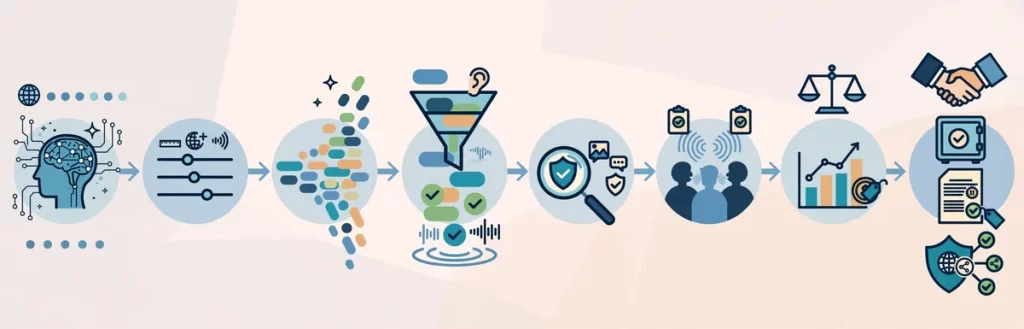
- Define your constraints first. Set the exact length, preferred extension, industry tone, and any syllable or letter exclusions before generating anything.
- Generate a broad candidate list. Run your brief through an AI naming tool and export every result that clears basic availability, even ones that feel unusual at first glance.
- Filter for phonetic and pronunciation quality. Remove candidates that are hard to say on a phone call or that read ambiguously when typed without capitalization cues.
- Run a manual trademark and social-handle check. Confirm the shortlist is genuinely clear across registries, trademark databases, and the social platforms your brand will need.
- Test the shortlist with real people. Read the top five names aloud to colleagues or potential customers and note which ones require repetition or spelling clarification.
- Compare pricing against market data. Before buying or bidding, review current 5-letter domain cost and price range benchmarks so you know whether an asking price is fair.
- Follow the full acquisition process. Once you have a finalist, follow a structured purchase process; our step-by-step guide to buying a 5-letter domain covers escrow, transfer, and verification steps in detail.
- Secure matching extensions and handles where feasible. Lock down the .com alongside key social handles as soon as the deal closes, before the name gains any public visibility.
ROI Considerations for AI-Discovered Domain Names
An AI-generated name does not carry inherent investment value simply because it was algorithmically produced. Value still comes from the same fundamentals that have always driven five-letter domain pricing: pronounceability, brandability across industries, extension quality, and genuine scarcity. What AI changes is discovery speed, not underlying worth.

Buyers should treat an AI-suggested five-letter name the same way they would treat one sourced manually: benchmark it against comparable recent sales, weigh how many industries it could plausibly serve, and confirm the extension matches buyer expectations in that vertical. A name that scores a 9 out of 10 on a naming tool’s pronounceability metric but has only ever been usable in one narrow niche will still underperform a broader, market-tested name on long-term resale.
Pricing Impact: How AI Naming Tools Affect 5-Letter Domain Costs
Because AI tools have made previously overlooked five-letter combinations easier to surface, average time-on-market for newly discovered inventory has shortened, and early data suggests this is applying gentle upward pressure on pricing at the lower and mid tiers of the market. Premium, already-established five-letter names with sales history are largely unaffected, since AI generation produces new candidates rather than replicating names that are already owned and branded.
For buyers, this means the window between “an AI tool surfaces a strong name” and “that name gets registered or listed by someone else” is shrinking. Moving quickly on a genuinely strong AI-generated shortlist candidate, after doing the necessary legal and market diligence, has become a meaningful competitive advantage.

The Future of AI Brand Naming Domain Tools
Expect three developments over the next few years. First, deeper integration between naming tools and trademark offices, moving automated screening closer to genuine legal-grade clearance rather than a surface-level scan. Second, multilingual scoring becoming standard, so a name is evaluated for cultural and phonetic fit across major global markets by default rather than as an optional add-on. Third, tighter integration between naming platforms and domain marketplaces themselves, allowing a generated name to be checked against active listings and historical sale comparables in the same workflow, rather than requiring a separate manual step.
None of this removes the need for curated marketplaces. If anything, as AI tools flood the market with more available candidates, the role of a marketplace that filters for genuine brand quality, resale liquidity, and legal cleanliness becomes more valuable, not less.
Frequently Asked Questions
What is an AI brand naming domain tool?
It is software that uses machine learning to generate brandable business names, check their live domain availability, and score them for pronounceability and memorability, all within a single automated workflow.
Are AI-generated 5-letter domain names trademark-safe?
Not automatically. Most AI tools only run a shallow trademark scan, so a manual search or legal review is still necessary before committing to any AI-suggested name.
Why are 5-letter domains the focus of most AI naming tools?
Five-letter dot-com inventory is the last tier with meaningful organic availability, since three- and four-letter combinations were largely exhausted years ago, making five letters the ideal proving ground for generation algorithms.
Can AI naming tools replace a branding agency?
They can replace the early brainstorming stage, but not the strategic, legal, and cultural review that a proper naming process still requires before launch.
How much does an AI-suggested 5-letter domain typically cost?
Pricing still follows standard market fundamentals rather than the fact that a name was AI-generated; buyers should compare any candidate against current market benchmarks before purchasing.
Do AI naming tools work across different industries?
Most tools let you specify an industry or tone, but output quality varies, and names that work well for consumer tech brands often need additional review before fitting more regulated industries such as finance or legal services.
Final Word

AI brand naming domain tools have genuinely changed how fast founders can move from a blank page to a shortlist of available five-letter names, and that speed has reshaped buying behavior across the entire market. But speed only gets a founder to the shortlist stage. The names that hold long-term value, resell well, and actually carry a business for a decade still need the judgment a curated marketplace brings: legal clearance, market comparables, and an honest read on brand fit. If you are ready to move from an AI-generated shortlist to a name you can actually build a company on, explore verified, ready-to-transfer five-letter domains at Aufic and skip the guesswork entirely.